


As temperatures drop and seasons change, there’s no better time to introduce winter science experiments into your classroom. No matter what grade you teach, winter offers countless opportunities for hands-on exploration that tie into learning.
Winter themed science experiments not only make learning fun but also encourage students’ critical thinking skills and help them apply scientific reasoning to the world around them.
The Importance of STEM
STEM— science, technology, engineering, and mathematics— is the foundation for innovation and problem-solving in today’s world. A strong STEM education helps students develop critical thinking skills and apply what they learn to real-world situations.
STEM education also prepares students for a rapidly evolving future. Whether students pursue science careers or not, the curiosity, critical thinking, and creativity that STEM provides will equip them to thrive in any field.
6 Winter Science Experiments
Hands-on winter science experiments are a great way to capture students’ attention while reinforcing key scientific principles.
You’ll note that each of the activities below has an extension for secondary learners. Here’s a quick summary of the skills you can apply when working with older students:
- Quantitative Data Collection: Measure, record, graph.
- Variable Control: Manipulate one variable (temperature, concentration, material) and hold others constant.
- Real-World Application: Connect to engineering, environmental, and physical science.
- Design: Have students redesign based on results, make hypotheses, and test again.
From exploring states of matter to investigating thermal insulation, these six easy winter STEM activities bring abstract concepts to life.

1. Make a Snowstorm in a Jar
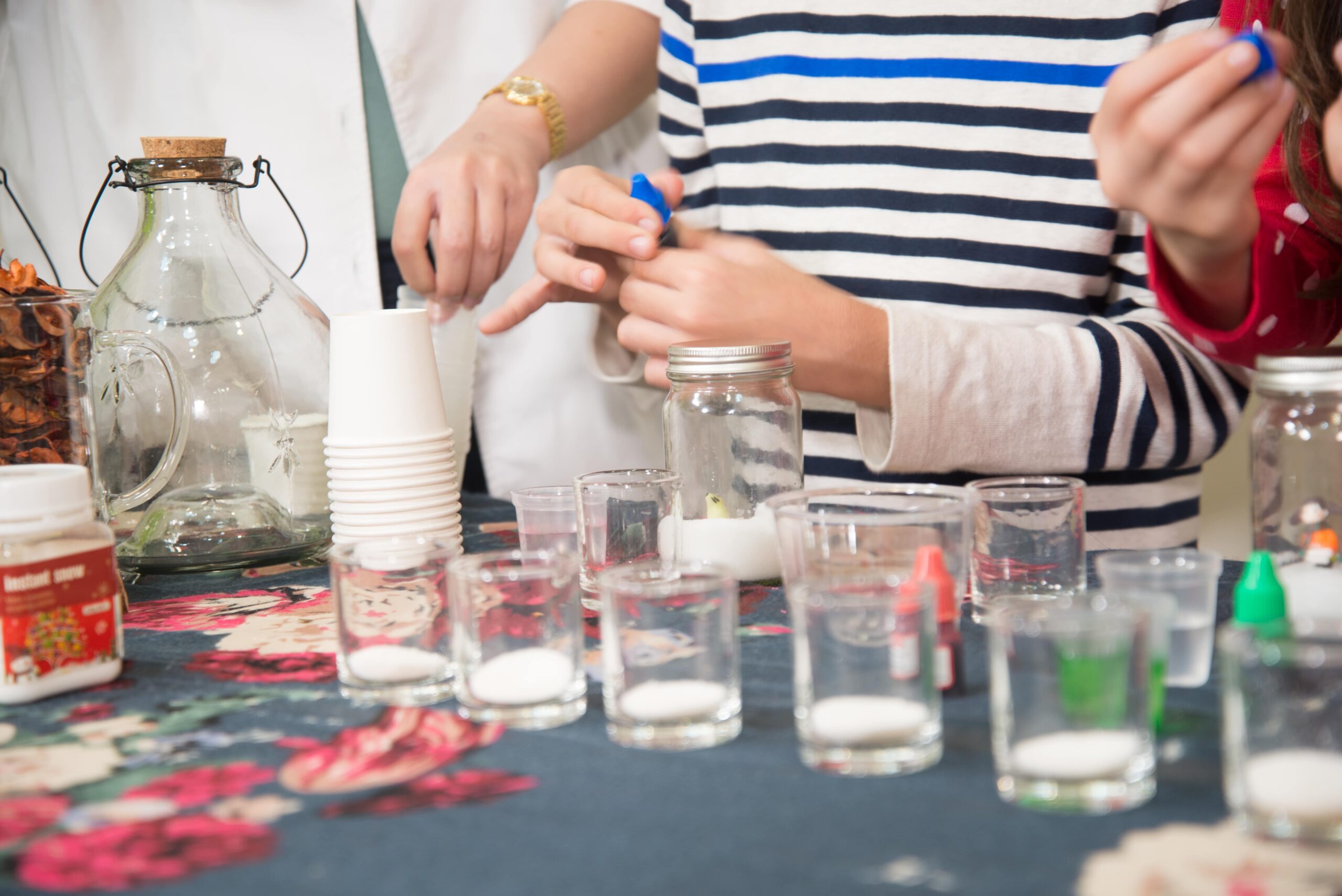
This classic winter science experiment allows students to create a miniature “snowstorm” in a jar using everyday household materials. It’s a great introduction to concepts of density, solubility, and chemical reactions.
What You’ll Need:
- Clear jar
- Cup
- Baby oil
- White paint
- Water
- Effervescent tablet (i.e., Alka-Seltzer)
How It Works:
- Fill a clear jar ⅔ full with baby oil.
- In a separate cup, mix warm water with white paint.
- Pour the mixture into the jar (it will sink below the oil).
- Drop in a piece of an effervescent tablet and watch as the bubbles carry “snowflakes” through the liquid
Why It Works:
Students will observe how oil will not mix with water because of their different densities. The bubbles created by the tablet rise through the oil, carrying water and paint droplets that resemble falling snow.
Level It Up:
Have older students measure reaction rates by timing how long each “snowstorm” lasts using different water temperatures or amounts of the tablet. They can record quantitative data, graph their results, and analyze how temperature affects chemical reaction speed.
2. Test Which Melts Faster—Salted Ice or Plain Ice?
Students explore how salt affects the freezing point of water.
What You’ll Need:
- Ice cubes
- Salt
- Two containers
- Timer
- Cause-and-Effect Chart (FREE download)
How It Works:
- Place ice cubes in two identical containers.
- Sprinkle salt on one cube and observe.
- Record how long each takes to melt.
- Use a cause-and-effect chart to record observations.
Why It Works:
Salt lowers the freezing point of water, a process known as freezing point depression. This causes the salted ice to melt faster, making it an excellent demonstration of phase changes and solutions.
Level It Up:
Challenge older students to quantify the effect by measuring melt time and water volume. You may have them test different types of salts (i.e., table, rock, or sea) to see if it impacts the melt time. This also provides a direct real-world connection, as this same principle is used to melt snow on the road.
3. Create Insulated Ice Houses
This experiment gives students a hands-on way to explore heat transfer and insulation, which are essential concepts in both science and engineering.
What You’ll Need:
- Cups/boxes lined with different materials (cotton, aluminum foil, paper, or bubble wrap)
- Ice cubes
How It Works:
- Prepare boxes or cups with different linings.
- Place one ice cube in each.
- Leave them for an hour, then check how much each cube melted.
Why It Works:
Students will learn about heat transfer and insulation through this hands-on experiment.
Level It Up:
Secondary students can approach this as a design engineering project. Have them design and build icehouse prototypes to calculate the rate of melting by measuring water mass loss over time. You can also challenge them to create an insulating design that incorporates sustainability by using recyclable materials.
4. Freeze a Balloon and Watch It Shrink
This easy winter science activity introduces the relationship between air temperature and volume.
What You’ll Need:
- Two balloons
- Freezer
How It Works:
- Blow up two balloons.
- Place one in a freezer and leave the other at room temperature.
- After about 30 minutes, compare their sizes.
Why It Works:
As air cools, it contracts—making the balloon shrink. This activity demonstrates gas laws in an easily observable way.
Level It Up:
Older students can measure the change in circumference and calculate volume differences using formulas for spheres. You can also connect this to weather by discussing how temperature changes affect air pressure and contribute to winter weather, like cold fronts or snowfall.
5. Grow Crystal Snowflakes
This beautiful and easy winter science project lets students explore how crystals form.
What You’ll Need:
- Pipe cleaners
- String
- Pencil
- Borax (or salt/sugar)
- Hot water
- Jar or cup
- Prediction Chart (FREE download)
How It Works:
Before beginning the experiment, have students complete a Prediction Chart:
In the Clues column, list what they observe or know from the materials (borax, hot water, pipe cleaner, jar). In the What I Know column, write what they know about how materials dissolve or crystals form. In the Prediction column, record what they think will happen after the snowflake sits overnight.
- Twist pipe cleaners into a snowflake shape and tie a string to one end.
- Suspend it from a pencil so it hangs freely in a jar.
- Mix several tablespoons of borax into hot water until it is completely dissolved.
- Pour the mixture into the jar until the snowflake is submerged.
- Leave overnight and check back to see crystals formed along the pipe cleaner.
Why It Works:
As the water cools and evaporates, the solution becomes less able to hold the dissolved borax. The excess solidifies and attaches to the pipe cleaner, forming crystals. It’s a hands-on way to study evaporation, saturation, and the properties of solutions.
Level It Up:
Older students can test different solutes (salt, sugar, or borax) to compare crystal size and growth rate. Have them measure water temperature and time to see how these variables affect the results, then graph their data to analyze trends.
6. Build a Paper Bridge That Holds Snow
This engineering-based winter STEM challenge combines creativity and problem-solving as students test different bridge designs for strength. It’s a way to connect engineering concepts with a fun, wintry twist.
What You’ll Need:
- Paper (various types)
- Scissors
- Tape
- Small container of artificial snow, cotton balls, or marshmallows
How It Works:
- Using only paper and tape, have students design a bridge that can span a set distance (like between two books).
- Gradually add “snow” to the bridge until it collapses.
- Record how much weight it held before breaking.
Why It Works:
Students learn about load distribution and structural engineering. The bridge’s strength depends on its shape, support points, and how forces are distributed through the material.
Level It Up:
Older students can test multiple designs—arches, trusses, or folded supports—and calculate average load capacity. Encourage them to reflect on real-world engineering challenges like bridge building in snowy climates and the materials used to handle heavy loads.
By pairing hands-on discovery with inquiry-based discussion, you’re building future scientists, engineers, and problem solvers. When students see how scientific principles connect to the world around them, they deepen both their conceptual understanding and their curiosity to explore further.